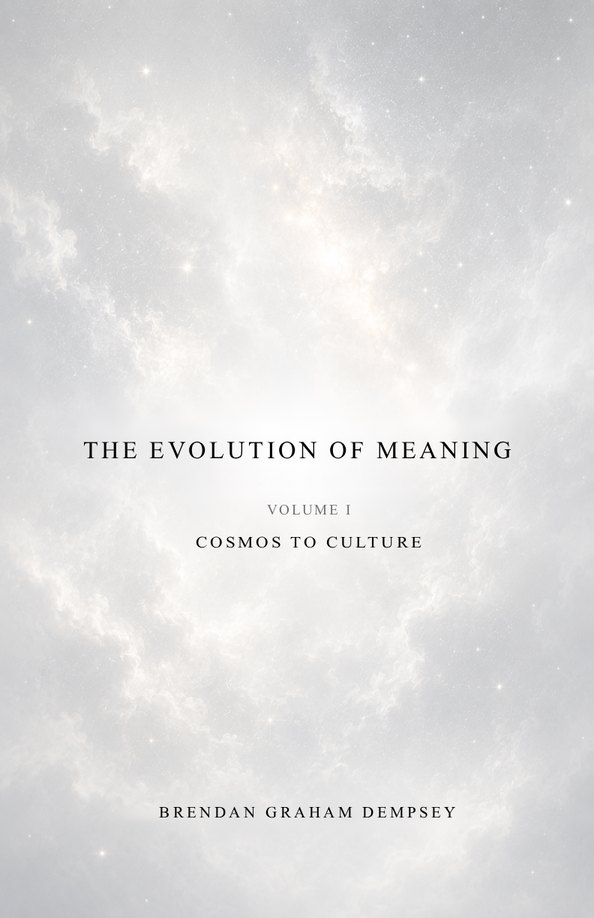
Volume I · Cosmos to Culture
A three-volume history of humanity's engagement with matters of ultimate concern — grounded in thermodynamics, measured in complexification data, and told as one continuous learning process running from the first structures of matter to the latest forms of the sacred.
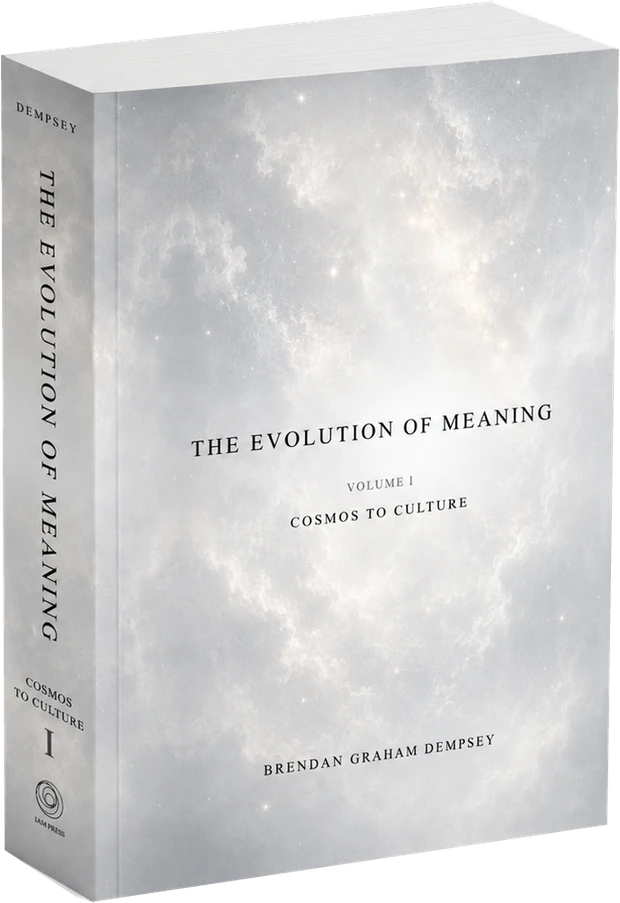
746 pages165 scored historical texts540+ scored developmental performances40+ figures
12:00 PM Eastern · Zoom & YouTube · Free and open to all
Join Brendan Graham Dempsey live for the release of Volume I — a conversation on the book's argument, its data, and where the three volumes go from here.
What is meaning? Ask what a thing means and you are usually pointed toward poetry or theology. This book points somewhere stranger: toward the second law of thermodynamics.
Everything that persists must pay for its own improbability. Structures hold together only by drawing free energy from an environment that is otherwise pulling them apart. To pay that price, a system has to know something true about where it lives — and it has to ignore almost everything else. Information that helps a system keep existing is meaningful to it. Information that doesn't is noise it cannot afford.
That single move — defining meaning in terms of information and energy — is what lets the rest of the book unfold. Because if meaning is the knowledge that keeps a system far from equilibrium, then meaning is not a late human ornament on a blank cosmos. It is the currency of complexity everywhere, from a crystal lattice to a genome to a nervous system to a civilization's idea of God. This complexity can be tracked and even measured — which is what this book endeavors to do.
A definition of meaning has to work at every scale or it works at none. Kolchinsky and Wolpert (2018) supply one that does: semantic information is the information a system holds about its environment that is causally necessary for the system to keep existing. Everything else is syntax — real, measurable, and beside the point.
It sounds austere. It is also, the book argues, the seed of everything we later call value, care, and the sacred. The module below lets you test it: pick a system, choose what it attends to, and watch what survives.
Pick a system. Then choose what it should pay attention to. Attention costs energy, so every channel you open has to earn its keep. Only the channels that bear on the system's own persistence are semantic information — meaning, in Kolchinsky and Wolpert's sense. The rest is expensive noise.
Kolchinsky & Wolpert define semantic information as the syntactic information a physical system holds about its environment which is causally necessary for the system to maintain its own existence. Chapter 1 extends that definition upward — through genes, nervous systems, and finally symbols — until it can carry the weight of the word sacred.
The universal learning process does not proceed uniformly. It proceeds through four qualitatively distinct registers, each riding on the one before, each processing meaningful information in its own currency.
Structural learning belongs to Matter, filtering viable configurations from the merely possible. Genetic learning belongs to Life, writing what works into the code of the gene. Cognitive learning belongs to Mind, modelling the world fast enough for a body to act on it. Symbolic learning belongs to Culture, holding meaning in language shared between minds rather than locked inside any one of them.
Through these increasingly complex forms of learning, purpose and value emerge to grow ever richer, more comprehensive, and more integrated — a path connecting the crudest information processing in the early cosmos to the most complex meaning-making humanity has produced.
What does the complexification of meaningful information look like for humans?
Dempsey examines how the socialized mind acquires increasingly adaptive knowledge. Summarizing 150 years of research in developmental psychology, he shows how our conceptions of morality, value, self, and God evolve as the psyche grows more complex. Moreover, he demonstrates how these transformations can be scientifically measured using the Lectical scoring of hierarchical complexity.
Doing so reveals major structures or types of meaning-making that unfold across the developmental spectrum. Such data allow us to update earlier integrative models of psychology with quantifiable rigor and precision.
Parenthetical entries are theoretically expected but not yet scored.
Figures and correlation coefficients reproduced from Measuring Altitude (Institute of Applied Metatheory, 2026), where the full methodology, datasets and statistics are reported.
Do societies learn too? Chapter 3 says yes, and shows the mechanism: persons and societies build each other. Individuals inherit language, norms, and institutions; a few push past them; what those few externalize becomes the next generation's inheritance.
Run that loop for seventy thousand years and six recognizable systems of meaning appear — each with its own sacred, its own values, its own energy base, and its own communication technology.
Dempsey measured the complexity of 165 texts representative of these historical worldview structures. The results revealed a clear complexification trend across time.
Scores as delivered to the Institute of Applied Metatheory by Lectica. Dates are the composition dates used in the study; Tribal texts are oral narrative recorded in the modern era and placed at a conventional Paleolithic marker, since they stand as proxies rather than as dated documents. Full methodology, statistics, and discussion in Chapter 3.
Universal Development Theory is the book’s integrative metatheoretical frame: it offers one account of complexification that holds from the first structures of matter to the latest forms of culture. Its core claim is that the cosmos did not invent one way of holding onto meaningful knowledge. It invented four, each riding on the one below, each with its own language and its own measurable signature.
Matter learns structurally, by keeping configurations that persist. Life learns genetically, by writing what worked into DNA. Mind learns cognitively, by modelling the world in nerves fast enough to act on it. Culture learns symbolically, by sharing meanings between minds so that what one person figures out need not die with them.
Each layer is genuinely emergent — you cannot read culture off chemistry — and each raises the ceiling of what can be meant. Turn the mandala below to see how the same story reads at every scale.
Each sphere nests inside the last, complexity increasing inward. The horizontal axis runs from interior to exterior, the vertical from singular to plural; the four diagonals track what an entity is, what it experiences, what it belongs to, and how its collectives hold meaning at each level. The fine arcs inside the Noosphere are the Lectical Scale, 900 to 1400. Click or hover a sphere.
If the sacred is what a culture holds most vital to its own flourishing, and cultures learn, then the sacred develops. Not merely changes — develops. The move from a genocidal war deity to Love itself is not a catalogue of successively less ridiculous delusions. It is a maturation, and the book takes seriously the possibility that what matured was not only our theology but its object.
That requires distinguishing what the word can even mean. Dempsey lays out a spectrum, and a five-part model for holding it together.
The model is naturalistic without being deflationary: God as an emergent, participatorily enacted, causally efficacious process — closer to a murmuration than to a person, and closer to a person than to a fiction. Chapters 4 onward read the resulting history as, in the book's phrase, the Bildungsroman of God.
Volume I builds the instrument. Volumes II and III use it — walking the whole history of the sacred, worldview by worldview, text by scored text.
Meaning from thermodynamics to theology. The universal learning process, the psychology of complexification, the first empirical measurement of cultural evolution, and a developmental theology.
The deep history, across three worldviews. The Tribal world of potency — amoral, negotiable, alive in rock and river. The Archaic domestication of that potency into named gods housed in temple and palace. And the Axial revolt, which set a transcendent moral order against imperial power and put something above the king.
Disenchantment and after, across three worldviews. The Modern turn that made the cosmos a mechanism and the sacred a redundancy. The Postmodern turn that made meaning itself the problem. And the Integrative turn now under way, which takes the reflexivity of the last and builds with it rather than only dismantling.
Volume I: Cosmos to Culture
Available October 1 — retail links go live on release day.
Join Brendan Graham Dempsey and Nick Hedlund for a conversation on the book, followed by Q&A. Free, on Zoom.